The Power of Mindset: Growth vs. Fixed Mindset in Achieving Your Goals
Growth mindset empowers entrepreneurs to embrace challenges and persist toward goals, while fixed mindset limits potential by fearing failure. Adopting a growth mindset drives business success through continuous learning and adaptability. Transform your approach to achieve lasting results. Mindset Definitions Growth mindset views abilities as developable through effort and feedback, fostering resilience. Fixed mindset sees talents as innate, avoiding risks to protect self-image. Carol Dweck's research highlights this divide in professional outcomes.
Shobhit Goyal
1/5/20267 min read
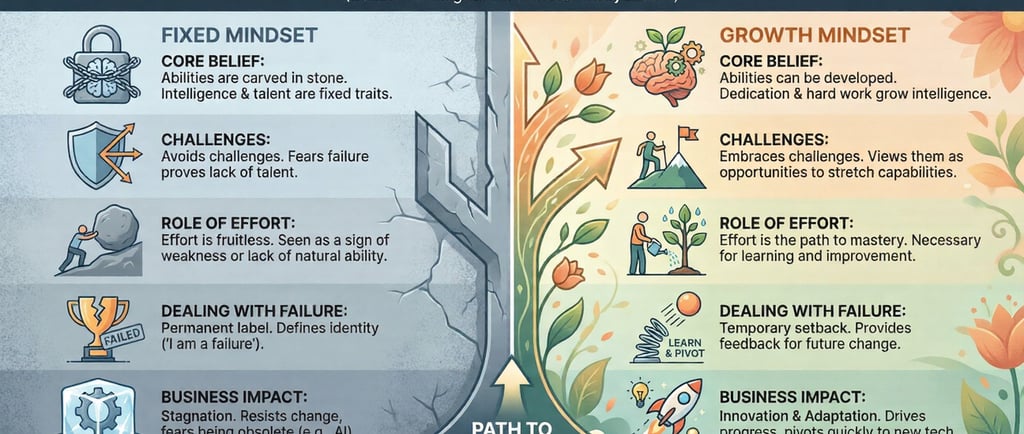
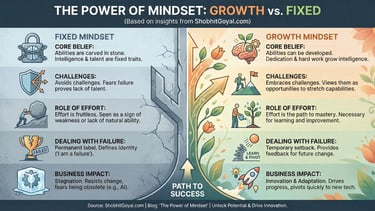
Understanding Mindsets: Growth vs. Fixed
Mindsets play a critical role in how individuals approach challenges, learn from experiences, and ultimately achieve their goals. The concept of growth and fixed mindsets, introduced by psychologist Carol Dweck, highlights two distinct approaches to personal development.
A growth mindset refers to the belief that abilities and intelligence can be developed through dedication, hard work, and perseverance. Individuals with this mindset embrace challenges, viewing them as opportunities for growth and learning. For instance, when faced with a difficult task, they are more likely to put in the effort to improve their skills rather than shy away from it. This resilience not only enhances their potential but also fosters a love for learning, allowing them to thrive in various aspects of life.
Conversely, a fixed mindset is characterized by the belief that intelligence and abilities are static traits that cannot be significantly changed. Individuals who hold a fixed mindset often avoid challenges, fearing failure and the potential damage to their self-esteem. This viewpoint can lead to a lack of effort in learning and, over time, can limit their ability to reach their goals. Instead of viewing obstacles as avenues for development, they may see them as threats that could expose their perceived limitations.
Understanding the differences between these two mindsets is vital, as they fundamentally influence one’s approach to tasks, relationships, and personal aspirations. By consciously cultivating a growth mindset, individuals can develop a more resilient attitude towards life’s challenges, ultimately enhancing their capacity to achieve their goals.
The Impact of Mindset on Goal Achievement
The mindset of an individual profoundly influences their ability to achieve goals. A growth mindset is characterized by the belief that abilities and intelligence can be developed through dedication, hard work, and perseverance. This perspective empowers individuals to embrace challenges, learn from criticism, and persist in the face of setbacks. For instance, a student who believes they can improve their mathematical skills may tackle difficult problems head-on, viewing mistakes as opportunities for learning rather than as failures. This adaptive response not only facilitates learning but also fosters resilience, enabling individuals to stay motivated and continue striving towards their objectives.
In contrast, a fixed mindset can severely limit one's potential. Individuals who adopt this mindset believe that their talents are innate and unchangeable. Consequently, they may avoid challenges due to a fear of failure, preferring to stay within their comfort zones. For example, an employee convinced that they lack the skills for a leadership role might hesitate to pursue such opportunities, ultimately limiting their professional growth and aspirations. Such avoidance can hinder progress and result in stagnation, as the individual may miss out on valuable experiences that could enhance their abilities and confidence.
Research has consistently shown that individuals with a growth mindset are more likely to achieve their goals compared to those with a fixed mindset. They tend to set higher aspirations, demonstrate greater engagement in their tasks, and develop more effective strategies for overcoming obstacles. By cultivating a growth mindset, individuals not only improve their chances of success but also create a healthier relationship with failure, viewing it as a teaching moment rather than a detrimental setback.
Mindsets and Personal Identity: Who Are You?
Our mindset significantly shapes our self-perception, influencing the way we see ourselves and the decisions we make regarding our future. When we adopt a growth mindset, we begin to view ourselves not as fixed entities but as individuals capable of change and development. This perspective enables us to embrace challenges as opportunities for learning, rather than obstacles to our potential.
A growth mindset fosters a more adaptive identity, which encourages individuals to focus on personal evolution and the pursuit of new skills. When faced with setbacks, those with a growth mindset are more likely to reassess their strategies and seek alternative paths toward their goals. This results in a more resilient self-concept, one that persists through difficulties.
Conversely, a fixed mindset can limit our identity by reinforcing negative beliefs about our capabilities. Individuals with a fixed mindset may define themselves by their perceived limitations, leading to avoidance of challenges. This stagnant self-image adversely affects decision-making regarding personal and professional growth. They may shy away from opportunities that could enrich their experience and expand their capabilities.
Adopting a growth mindset allows us to identify our potential and redefine our identities based on our efforts and achievements. Emphasizing personal strengths and acknowledging areas for improvement fosters a sense of agency over our lives. Moreover, a growth-oriented identity promotes continuous learning, adaptability, and the willingness to take risks, which is essential for long-term success.
In essence, by cultivating a growth mindset, we can evolve our personal identity, steering ourselves toward a future filled with possibilities and accomplishments. This active engagement with our self-perception is crucial as it empowers us to pursue our goals with confidence and resilience.
Case Studies: Real-Life Examples of Mindsets in Action
Understanding the impact of growth and fixed mindsets can be greatly enhanced through real-life examples that illustrate how these mental frameworks manifest in various contexts. One compelling example of a growth mindset is that of Thomas Edison. Having faced numerous failures while inventing the light bulb, Edison famously stated that he had not failed, but rather discovered 10,000 ways that wouldn’t work. This tenacity exemplifies a growth mindset as he viewed each setback as an opportunity for learning and improvement, ultimately leading to his monumental success. Edison's journey highlights how perseverance and adaptability characteristically associated with a growth mindset can lead to groundbreaking innovations.
In contrast, one might consider the story of Kodak, a company that epitomized a fixed mindset during a key transitional period in its history. As digital photography began to emerge, Kodak, which pioneered film photography, failed to adapt to this technological shift. Management clung to traditional revenue models and expressed skepticism about the viability of digital photography. This reluctance to evolve and embrace change demonstrated a fixed mindset, ultimately leading to Kodak's decline and bankruptcy in 2012. The inability to view challenges as avenues for growth played a crucial role in their failure to sustain relevance in a rapidly evolving industry.
Additionally, within the realm of education, Carol Dweck, the psychologist who coined the terms "growth mindset" and "fixed mindset," conducted insightful studies demonstrating these mindsets in students. In her research, students who were praised for their effort rather than their innate ability were more likely to embrace challenges and persist in the face of difficulties, while those who received praise for intelligence often avoided challenges for fear of failure. This evidence clearly illustrates how the endorsement of a growth mindset not only enhances academic performance but also fosters resilience and a love for learning.
Identifying Your Own Mindset: Self-Assessment Tools
Recognizing whether you possess a growth or fixed mindset is crucial for personal development. Fortunately, there are several self-assessment tools and strategies available to assist in this identification process. One effective approach is to engage in reflective exercises that encourage honest evaluation of your thoughts and behaviors.
Begin by considering a recent challenge you faced. Ask yourself how you reacted: Did you view it as an opportunity for growth, or did you feel defeated and inclined to give up? Recording your thoughts in a journal can provide clarity and help identify recurring patterns in your responses. This qualitative self-assessment offers valuable insights into your mindset.
Another practical method is to utilize mindset quizzes that are widely available online. These quizzes typically consist of statements related to personal beliefs and attitudes towards learning, effort, and failure. By responding honestly to these prompts, you can gain a clearer picture of your predominant mindset tendencies. Keep in mind that identifying specific traits related to growth or fixed mindsets may also help you recognize areas for improvement.
Furthermore, it is beneficial to observe your language when discussing goals and obstacles. Do you often use phrases that imply limitations, such as "I’m just not good at this," or do you frame challenges as opportunities for learning? This self-monitoring can serve as an indicator of your mindset orientation.
Incorporating feedback from trusted friends or mentors can also be illuminating. They can provide an external perspective that may reveal aspects of your mindset that you might not see in yourself. By implementing these self-assessment tools and strategies, you will be better equipped to recognize whether you have a growth or fixed mindset, thus paving the way towards more effective goal achievement.
Strategies for Shifting from a Fixed to a Growth Mindset
Transitioning from a fixed mindset to a growth mindset involves practical strategies that encourage personal development and resilience. One effective approach is to reframe challenges as opportunities. Instead of viewing obstacles as barriers, consider them as a chance to learn and improve. This can be achieved through positive self-talk, emphasizing progress rather than perfection. For example, when confronted with a difficult task, remind yourself of past achievements that required effort and adaptation.
Embracing failures is another vital step in cultivating a growth mindset. Instead of perceiving failure as a reflection of limitations, reframe it as a valuable learning experience. Research indicates that individuals who analyze their failures and extract lessons demonstrate greater perseverance and success in the long term. Reflecting on what went wrong and identifying actionable steps can enhance resilience and empower one to tackle future challenges.
Moreover, creating a learning-oriented environment is essential for fostering a growth mindset. Surround yourself with supportive individuals who encourage risk-taking and innovation. Engage in discussions that promote curiosity and exploration. Collaborating with others who share a focus on learning can provide motivation and diverse perspectives. Furthermore, setting specific, achievable goals can aid in reinforcing a growth mindset. Establishing a trajectory of personal development allows individuals to celebrate incremental successes, thereby enhancing motivation.
Incorporating daily practices, such as journaling your thoughts about challenges and growth experiences, can further support the shift to a growth mindset. Tracking progress and reflecting on positive changes reinforces the belief that abilities can be developed through effort and learning. Ultimately, the journey from a fixed to a growth mindset requires persistence and an openness to new experiences, backed by a commitment to self-improvement.
Conclusion: The Lifelong Journey of Mindset Development
Throughout this exploration of growth and fixed mindsets, it is clear that the mindset we adopt plays a pivotal role in shaping our experiences, outcomes, and overall life satisfaction. A growth mindset empowers individuals to view challenges as opportunities for learning and development, fostering resilience in the face of obstacles. In contrast, a fixed mindset can result in stagnation, limiting personal and professional growth.
The journey of cultivating a growth mindset is not a destination but a lifelong commitment to continuous self-improvement and flexibility in thought. This ongoing process involves engaging with new ideas, confronting fears, and embracing challenges with courage and determination. It encourages individuals to step out of their comfort zones and adopt a learner's attitude, understanding that effort and perseverance are key components of success.
Moreover, adopting a growth mindset can have profound effects not only on personal achievement but also on interpersonal relationships and workplace dynamics. Encouraging a culture that values learning, feedback, and innovation can lead to improved collaboration and overall productivity. As we strive to develop our mindsets, we also inspire those around us to do the same, creating a ripple effect that encourages a collective pursuit of excellence.
In conclusion, every individual has the capacity to shape their mindset throughout their life. Whether one has encountered setbacks or experienced successes, the road to growth is always open. By embracing challenges, seeking knowledge, and nurturing a resilient spirit, we can navigate our paths towards achieving our goals. Let us embark on this journey of lifelong learning and mindset development, committed to realizing our fullest potential and empowering others along the way.
Contact
Let's connect and grow your digital presence.
Phone
info@shobhitgoyal.com
+918103354280
© 2025. All rights reserved.
UDYAM REGISTRATION NUMBER :- UDYAM-MP-49-0093568