Harnessing Intelligent IoT and Digital Twins for Smart Solutions
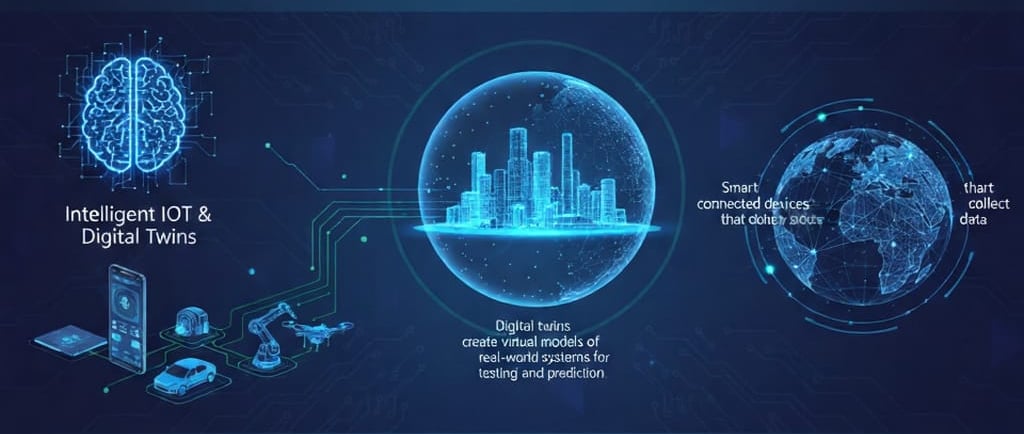
Intelligent IoT & Digital Twins Smart connected devices that collect real-time data. Digital twins create virtual models of real-world systems for testing and prediction.
Shobhit Goyal
2/9/20268 min read
Introduction to Intelligent IoT
Intelligent Internet of Things (IoT) represents a paradigm shift in the way devices interconnect, exchange information, and provide actionable insights. At its core, Intelligent IoT involves the integration of smart devices with advanced technologies that enable them to analyze data in real-time. This capability is crucial in sectors such as manufacturing, healthcare, and smart cities, where the volume of data generated necessitates efficient processing and decision-making.
One of the foundational elements underlying Intelligent IoT is the deployment of sensors. These devices play a pivotal role by collecting vast amounts of data from their environment. For instance, temperature sensors in smart buildings allow for precise climate control, ensuring energy efficiency while enhancing occupant comfort. Such sensors not only gather data but also facilitate the transformation of everyday objects into smart devices, thus enhancing their functionality.
Connectivity is another cornerstone of Intelligent IoT. High-speed internet, wireless technologies such as 5G, and protocols like MQTT create a robust framework for devices to communicate seamlessly. This connectivity allows for the transfer of real-time data to centralized systems or cloud environments where advanced data analytics can be performed. The insights gleaned from this analysis enable proactive decision-making and facilitate automated responses, thereby creating a responsive ecosystem.
Moreover, data analytics employs machine learning and artificial intelligence to identify patterns and trends within the collected data. This capability empowers organizations to predict maintenance needs, optimize supply chains, and enhance customer experiences. By leveraging the synergy between sensors, connectivity, and data analytics, Intelligent IoT fosters a smart ecosystem capable of adapting to dynamic situations, thus presenting endless opportunities for innovation and efficiency.
Understanding Digital Twins
A digital twin is defined as a digital representation of a physical object, system, or process. This virtual model acts as a comprehensive mirror to its real-world counterpart, enabling detailed analysis and insights through simulations. The concept of digital twins facilitates the monitoring and evaluation of performance by imitating and predicting the behavior of systems over time. Organizations can leverage these models for critical decision-making, process optimization, and strategic planning.
One of the key benefits of digital twins is their capability to simulate real-world scenarios. By integrating real-time data from various sensors and IoT devices, digital twins can dynamically adjust to reflect actual conditions. This allows businesses to anticipate potential issues, optimize operational performance, and improve lifecycle management. For example, in manufacturing, a digital twin of a production line can identify bottlenecks, assess machinery wear, and propose solutions to enhance efficiency.
Digital twins have garnered significant attention across various industries, including healthcare, aviation, and smart cities. In healthcare, digital twins can be used to create personalized treatment plans by simulating patient responses to therapies. In aviation, airlines utilize digital twins of aircraft to enhance maintenance practices and improve safety standards. The implementation of digital twins in smart cities allows city planners to foresee infrastructure needs and optimize resource allocation effectively.
As digital transformation accelerates, the importance of digital twins in enabling smart solutions continues to grow. By providing a platform for predictive analytics and real-time monitoring, digital twins not only enhance operational efficiency but also contribute to innovation and sustainability in multiple sectors. Their role in integrating IoT and advanced analytics is crucial for building a smarter, more connected future.
The Synergy Between Intelligent IoT and Digital Twins
The convergence of Intelligent Internet of Things (IoT) and Digital Twins represents a significant advancement in the digital transformation journey across various industries. Intelligent IoT enables devices to communicate, analyze, and act upon real-time data. In contrast, Digital Twins serve as virtual replicas of physical entities, allowing organizations to simulate and optimize processes. The synergy between these two technologies brings forth unparalleled opportunities for enhanced operational efficiency and informed decision-making.
Real-time data captured by Intelligent IoT devices plays a pivotal role in enriching the functionality of Digital Twins. Sensors deployed in physical assets continuously gather valuable insights, including performance metrics, environmental conditions, and usage patterns. This influx of information allows the Digital Twins to evolve dynamically, reflecting changes in the real world and facilitating predictive maintenance. By accurately representing the current state of equipment and processes, businesses can identify potential issues before they escalate, driving down costs and minimizing downtime.
Moreover, the integration of Intelligent IoT with Digital Twins enables organizations to simulate various scenarios based on real-time data. This capability empowers enterprises to explore the outcomes of distinct decisions without incurring physical risks or costs. For instance, in manufacturing, Digital Twins can simulate production lines to identify bottlenecks or optimize resource allocation in response to fluctuations in demand. Therefore, when harnessed together, Intelligent IoT and Digital Twins provide a comprehensive framework that fosters innovation and agility in operations.
As industries continue to embrace digital technologies, understanding the interplay between Intelligent IoT and Digital Twins becomes essential. This integration not only facilitates superior data analysis and operational responsiveness but also sets the foundation for creating intelligent ecosystems that drive long-term sustainability and growth.
Applications of Intelligent IoT in Various Industries
The Intelligent Internet of Things (IoT) has emerged as a transformative force across multiple sectors, driving efficiency and innovation. Primarily characterized by a network of interconnected devices that gather and exchange data, Intelligent IoT facilitates myriad applications tailored to meet specific industry needs. In the manufacturing sector, for example, connected sensors monitor equipment health in real-time, thus optimizing maintenance schedules and minimizing downtime. A pertinent case study reveals how a major automotive manufacturer implemented IoT-enabled sensors on production lines. This resulted in a 25% reduction in unplanned downtime, demonstrating the profound impact of real-time data on operational efficacy.
Healthcare is another sector experiencing significant advancements through Intelligent IoT applications. Wearable devices that track patient vitals generate continuous streams of data, enabling healthcare professionals to monitor conditions without the confines of traditional office visits. A notable example is the deployment of connected heart monitors, which alerted providers to irregular heart rhythms in patients, allowing for timely interventions and health improvements. Such implementations underscore the potential of Intelligent IoT to enhance patient outcomes while reducing the burden on healthcare systems.
In the energy sector, Intelligent IoT technologies play a crucial role in optimizing resource management and enhancing sustainability. Smart meters provide real-time consumption data to consumers and utility providers alike, promoting energy conservation and efficient usage. A case study of a municipal energy company illustrates how the integration of smart meters resulted in a 15% reduction in energy usage across its user base. This not only reflects the efficacy of Intelligent IoT in promoting environmental responsibility but also highlights the economic benefits derived from its implementation.
These case studies exemplify the myriad applications of Intelligent IoT across different industries, showcasing its capability to deliver substantial operational efficiencies and improved service outcomes. The integration of smart connected devices and the data they generate stand as a testament to the transformative potential of Intelligent IoT in shaping industry practices.
Impact of Digital Twins on Product Development
Digital twins are rapidly transforming product development and lifecycle management by creating accurate virtual replicas of physical products. By leveraging real-time data from sensors and other IoT devices, companies can simulate various scenarios and workflows, allowing for enhanced design and innovation. This capability enables engineers and designers to visualize the product in a controlled environment, minimizing the risks that typically come with physical prototypes. As a result, digital twins facilitate faster iterations and refinements, which ultimately accelerates time to market.
Enhancing Testing and Maintenance
The role of digital twins extends beyond initial product development. These sophisticated models are invaluable during the testing and maintenance phases of a product's lifecycle. They enable companies to conduct detailed analyses without the need for extensive physical tests, thus reducing costs associated with material use and time. For instance, simulations using digital twins can predict how a product will perform under various conditions, offering insights that help identify vulnerabilities before they impact the consumer. This proactive approach not only improves performance but also enhances product reliability.
Driving Customer Satisfaction
Furthermore, the deployment of digital twins contributes to customer satisfaction by allowing manufacturers to provide tailored solutions. By using data derived from real-world usage, companies can monitor product performance and predict potential issues before they become critical. This predictive maintenance ensures that products are serviced before failures occur, significantly enhancing reliability. As a result, companies can foster stronger relationships with their customers, establishing a reputation for quality and dependability within the market.
Conclusion
In conclusion, digital twins are revolutionizing product development and maintenance by enabling more efficient design, thorough testing, and proactive maintenance strategies. As organizations continue to harness the potential of these digital counterparts, they stand to gain significant competitive advantages through innovation, cost reduction, and improved customer satisfaction.
Challenges and Solutions in Implementing IoT and Digital Twins
The integration of Intelligent IoT and Digital Twins into organizational frameworks presents a myriad of challenges that must be effectively addressed to realize their full potential. One significant challenge is data security. As these technologies often involve the collection and transmission of vast amounts of sensitive information, organizations face risks related to cyber threats and unauthorized access. To mitigate these risks, implementing robust cybersecurity measures, such as encryption and multi-factor authentication, is essential. Furthermore, regular security audits should be conducted to identify vulnerabilities within the system.
Another challenge involves system interoperability. Organizations may find themselves utilizing various devices and platforms with disparate protocols and standards, which can result in integration difficulties. To overcome this, organizations should adopt open standards and frameworks, which encourage compatibility among different devices and applications. By fostering an ecosystem that supports interoperability, organizations can streamline their operations and enhance data exchange.
The need for skilled personnel also poses a significant hurdle in the implementation of these technologies. The reliance on data scientists, IoT specialists, and IT professionals who are knowledgeable about digital twins can lead to resource shortages. To address this, organizations can invest in training and development programs designed to upskill their existing workforce. Partnering with educational institutions to create tailored curricula can also bridge the skills gap and ensure a steady pipeline of qualified professionals.
Additionally, fostering a collaborative approach among various departments can enhance the adoption of Intelligent IoT and Digital Twins. By encouraging cross-functional teams to work together, organizations can cultivate a culture that embraces technological advancements, thereby facilitating smoother transitions and innovative solutions.
The Future of Intelligent IoT and Digital Twin Technologies
The landscape of Intelligent IoT and Digital Twin technologies is poised for transformative developments, with significant implications for various sectors. As these innovations continue to advance, they will increasingly facilitate enhanced efficiency, automation, and connectivity in industries ranging from manufacturing to healthcare. One notable trend is the convergence of AI and machine learning with IoT and digital twins, resulting in systems that not only replicate physical entities but also provide predictive insights and real-time analytics. This integration is expected to refine decision-making processes by allowing organizations to simulate different scenarios and optimize operations dynamically.
Another prominent trend is the adoption of edge computing, which will complement Intelligent IoT and Digital Twins by processing data closer to the source, thereby reducing latency and enhancing response times. By minimizing the amount of data sent to centralized cloud servers, organizations can achieve faster analysis and ultimately drive quicker decision-making. Coupled with the growing prevalence of 5G technology, the potential for truly intelligent, real-time applications will increase significantly.
Moreover, as data privacy and security concerns continue to rise, the development of cutting-edge security protocols is essential for ensuring the safe deployment of Intelligent IoT and Digital Twin technologies. Enhanced cybersecurity measures will play a critical role in building trust and fostering wider adoption across industries. The implications of these technologies on society and the economy are immense, potentially redefining labor markets, promoting new business models, and influencing urban development through smart city initiatives.
Looking ahead, the collaboration between different industries—combining strengths in technology, data analysis, and domain expertise—will be crucial for maximizing the benefits of Intelligent IoT and Digital Twin technologies. As organizations recognize the value of these smart solutions, there is no doubt that they will continue to evolve, paving the way for innovative applications and unprecedented efficiencies in the future.
Contact
Let's connect and grow your digital presence.
Phone
info@shobhitgoyal.com
+918103354280
© 2025. All rights reserved.
UDYAM REGISTRATION NUMBER :- UDYAM-MP-49-0093568