Future Jobs After AI: What to Expect Between 2026 and 2030
The advent of artificial intelligence (AI) is heralding a transformative era across various industries, bringing with it both opportunities and challenges in the employment landscape. From healthcare to manufacturing, AI is being integrated to streamline processes, enhance efficiency, and ultimately drive productivity. As a result, many organizations are witnessing significant operational shifts, influencing not only how goods and services are produced and delivered but also the types of roles available in the workforce.
Shobhit Goyal
1/23/20268 min read
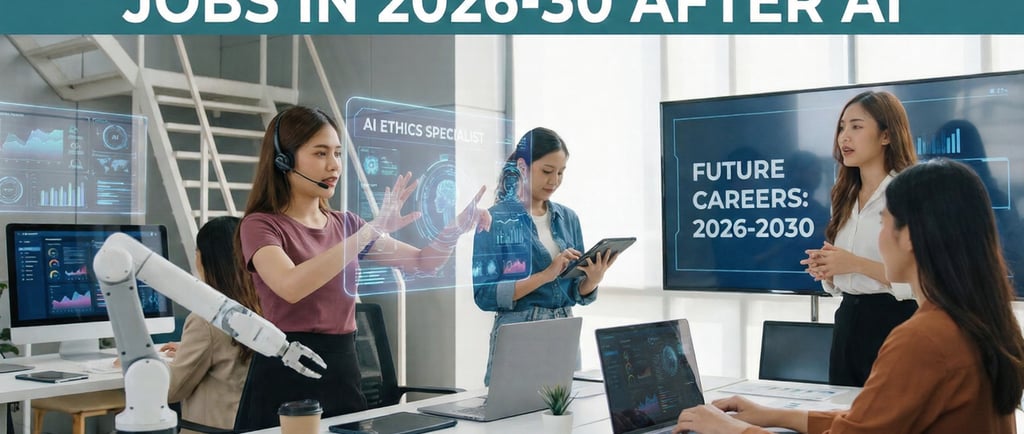
The AI Revolution and Its Impact on Employment
The advent of artificial intelligence (AI) is heralding a transformative era across various industries, bringing with it both opportunities and challenges in the employment landscape. From healthcare to manufacturing, AI is being integrated to streamline processes, enhance efficiency, and ultimately drive productivity. As a result, many organizations are witnessing significant operational shifts, influencing not only how goods and services are produced and delivered but also the types of roles available in the workforce.
One of the primary concerns surrounding the rise of AI is the potential for job displacement. Automation through AI technologies is capable of performing tasks traditionally handled by humans, leading to fears about rising unemployment rates. For instance, industries such as transportation and logistics face disruptions as self-driving vehicles and automated warehousing systems gain traction. The retail sector is similarly affected as AI-powered algorithms enhance online shopping experiences, potentially threatening jobs in physical stores.
However, it is important to recognize that while certain jobs may become obsolete, AI is also expected to create new employment opportunities. Roles emerging from this technology shift may include AI management, data analysis, and even maintenance of AI systems. This duality suggests that rather than a wholesale job loss, we are more likely to observe a significant evolution in the skill sets demanded by the job market. Individuals will need to adapt by acquiring new competencies that complement AI technologies, thereby positioning themselves for roles that require human insight and creativity.
This ongoing transformation necessitates a deeper understanding of the relationship between AI and employment. Current and future workers must navigate this landscape with agility, embracing lifelong learning to remain competitive. Recognizing the interplay between technological advancement and human labor will be vital in ensuring a prosperous transition into this new era.
The Role of AI in Shaping New Job Opportunities
The advent of artificial intelligence (AI) is profoundly influencing the workforce landscape, driving not only changes in job roles but also the creation of entirely new opportunities. As AI continues to evolve, various sectors are experiencing a transformation, leading to a burgeoning demand for skilled professionals who can effectively work alongside this technology.
In the technology sector, the emergence of AI has ushered in roles such as AI specialists and machine learning engineers, who develop algorithms and innovative systems aimed at enhancing efficiencies and tackling complex problems. These professionals are essential for businesses looking to integrate AI solutions into their operations, thus ensuring a competitive edge in an increasingly automated world.
Moreover, the healthcare sector is witnessing unprecedented advancements due to AI capabilities. Roles such as health informaticists and AI-enabled diagnostic specialists are becoming essential components of modern medical practice. These professionals leverage AI tools for data interpretation and patient management, resulting in more accurate diagnoses and personalized treatment plans. As healthcare continues to embrace technology, the demand for professionals who can bridge the gap between medicine and AI will grow significantly.
In finance, the emergence of AI-driven analytics is shaping new job opportunities in fields such as risk assessment and fraud detection. Financial analysts who understand AI applications can provide invaluable insights, enabling organizations to make data-driven decisions swiftly. This fusion of finance and technology will likely lead to an increase in these specialized roles.
Finally, in education, the incorporation of AI into learning methodologies is leading to roles such as instructional designers and educational data analysts. These professionals utilize AI to create personalized learning experiences, highlighting the importance of understanding both educational practices and technological advancements.
Overall, while AI may automate certain tasks, it simultaneously paves the way for new job opportunities across various sectors, underscoring the importance of adaptability and continuous skill development in this evolving job market.
Essential Skills for the Future Workforce
The rapid advancements in artificial intelligence (AI) are reshaping the labor market, leading to the emergence of new job roles and a transformed workforce. To adapt and thrive in this AI-driven environment between 2026 and 2030, professionals will need to cultivate a diverse set of skills. These skills can be broadly categorized into technical competencies and soft skills.
Technical skills will be paramount in the future job landscape. Proficiency in areas such as machine learning, data analysis, and programming languages will allow individuals to work effectively alongside AI technologies. As AI systems become integral to business operations, employees with the ability to interpret data, develop algorithms, and implement machine learning models will be in high demand. Alongside these abilities, knowledge of AI ethics and its implications will be critical, ensuring that technology is implemented responsibly in various sectors.
In addition to technical skills, soft skills will play a vital role in the future workforce. Being adaptable to change will be crucial, as the rapid pace of technological innovations requires individuals to continuously learn and pivot in their careers. Furthermore, creativity will become a desired trait, as AI takes over routine tasks, leaving room for human ingenuity in problem-solving and innovation. Exceptional interpersonal skills will also be important, as collaboration among diverse teams becomes the norm, necessitating effective communication and emotional intelligence.
Ultimately, the interplay between technical abilities and soft skills will define future job success in an AI-enhanced marketplace. Professionals who invest in developing a balanced skill set tailored to this evolving landscape will be better positioned to capitalize on opportunities, ensuring their relevance and effectiveness in a transformed workforce.
Industries Expected to Grow: A Look at Specific Job Categories
As we approach the years between 2026 and 2030, various industries are anticipated to experience significant growth as a direct consequence of advancements in artificial intelligence (AI). Among the most promising sectors are technology, healthcare, and education. Each of these fields is likely to demand a new wave of professionals equipped with skills that enable them to effectively navigate an AI-driven landscape.
In the technology sector, the role of AI ethics compliance officers is emerging as essential. These professionals will be responsible for ensuring that AI applications adhere to ethical guidelines and regulatory requirements, addressing concerns related to privacy, bias, and accountability. Similarly, the demand for data strategists is on the rise. Data strategists will interpret complex data sets generated by AI systems, ensuring organizations can leverage insights for informed decision-making while remaining compliant with data protection laws.
The healthcare industry is also set to evolve significantly due to AI advancements. Technical experts in telemedicine and health informatics will be crucial as healthcare facilities increasingly adopt AI tools to improve patient care and streamline administrative tasks. Moreover, AI-enhanced health data analysts will be sought after to analyze vast quantities of patient data, contributing to better healthcare outcomes through personalized treatment plans.
In the education sector, the implementation of AI technologies is expected to generate a need for instructional designers who specialize in AI-based learning solutions. These professionals will design curricula tailored to the unique needs of individual students by utilizing AI tools that enhance the learning experience. Furthermore, education data analysts will focus on evaluating the effectiveness of AI applications in classrooms, ensuring that educational goals are achieved efficiently.
Overall, as AI continues to shape various industries, professionals with specialized skills tailored to these changes will be in high demand, opening new pathways for career growth and innovation.
The Rise of Hybrid Jobs: Blending Human and AI Collaboration
The integration of artificial intelligence (AI) into various sectors is fostering the emergence of hybrid jobs—positions that necessitate a combination of human intuition and AI capabilities. These roles leverage the strengths of both human employees and technological systems, resulting in enhanced productivity and innovation.
One notable example of hybrid jobs can be found in sectors such as healthcare. Health informatics specialists, who harness AI-driven analytics to interpret patient data, require a deep understanding of clinical practices combined with technical proficiency in data analysis. This role exemplifies how human skill and technical knowledge can work in concert, actively improving patient outcomes through informed decision-making.
Furthermore, in the realm of marketing, professionals are increasingly blending creative instincts with AI tools to analyze consumer behavior and personalize campaigns. Marketing specialists who are adept at utilizing AI algorithms can create optimized strategies that engage audiences more effectively, demonstrating how these roles not only require creativity but also a solid grasp of AI capabilities.
Another sector poised for the rise of hybrid jobs is finance. Financial analysts equipped with AI tools can efficiently assess risks and predict market trends, capitalizing on data-driven insights while simultaneously applying their expertise in financial matters. This synergy between human analytical abilities and AI's computational power leads to more sustainable investment strategies.
Moreover, educators are beginning to navigate hybrid roles as well. With the adoption of AI-driven educational platforms, teachers are tasked with intertwining technological resources with traditional teaching methods. This balance allows for a more personalized learning experience, highlighting the teacher’s role in motivating and guiding students while leveraging technology for enhanced learning.
The hybrid job landscape represents a significant evolution in professional roles, suggesting a future where human creativity and emotional intelligence complement advanced AI functionalities, leading to greater job satisfaction and productivity.
As we progress further into the age of artificial intelligence (AI), the importance of lifelong learning becomes increasingly apparent. The rapid evolution of technology necessitates that professionals remain adaptable and continuously seek new knowledge and skills. This constant pursuit of education will be paramount for anyone aiming to maintain a competitive edge in the job market between 2026 and 2030.
Lifelong learning can take many forms. Professionals can engage with various resources, including online courses, workshops, webinars, and seminars that focus on emerging technologies and market trends. Institutions like Coursera, edX, and Udacity offer numerous programs tailored to the demands of AI and other fields, allowing individuals to pick and choose according to their career goals. Obtaining certifications in specialized areas such as data analytics, machine learning, or project management can also enhance one's skill set, making individuals more attractive to potential employers.
Another effective approach to lifelong learning is to participate in industry conferences and networking events. These gatherings provide opportunities to connect with experts and peers, exchange ideas, and stay informed about the latest advancements. Furthermore, engaging in mentorship programs can offer invaluable insights and guidance, helping individuals navigate their career paths in a landscape increasingly influenced by AI.
Organizations must also play a pivotal role in facilitating lifelong learning among their employees. By investing in training programs and creating a culture of continuous improvement, companies can foster an environment where learning is viewed as an integral part of professional development. This not only enhances employee satisfaction but also ensures that the workforce is equipped with the necessary skills to thrive amidst technological changes.
In conclusion, adaptability through lifelong learning will be vital in ensuring career resilience in the AI-driven job market of the coming years. By actively seeking educational resources, engaging in networking opportunities, and cultivating a mindset of continuous improvement, professionals can better prepare themselves for an uncertain future.
Conclusion: Embracing Change and Planning for the Future
The landscape of employment is undergoing substantial transformation due to the increasing influence of artificial intelligence (AI). As we approach the years between 2026 and 2030, it becomes imperative for individuals to embrace change proactively. The integration of AI across various sectors presents both challenges and unique opportunities for the workforce. To thrive in this evolving environment, it is essential for people to cultivate adaptability and resilience.
Notably, the emergence of AI-driven industries necessitates a shift in skills and roles. Workers must prioritize continuous learning and upskilling to remain competitive. This might involve enrolling in specialized training programs, pursuing higher education, or developing soft skills that are less susceptible to automation. By investing in education and professional development, individuals can better position themselves to take advantage of new job opportunities that arise as AI technology evolves.
Moreover, focusing on industries that augment rather than compete with AI is crucial. Fields such as healthcare, renewable energy, and advanced technology are likely to expand, generating new roles that require human creativity, empathy, and critical thinking. Networking and seeking mentorship in these sectors can further enhance one’s prospects for future employment.
In conclusion, while the transition influenced by AI may present uncertainties, it is also a time ripe with possibilities. By actively preparing for the future job market, individuals can navigate these changes more effectively. The key lies in adopting a forward-thinking mindset, embracing lifelong learning, and being open to new career paths. Through adaptability and proactive planning, one can harness the potential of AI advancements to forge a successful and fulfilling professional journey in the coming years.
Contact
Let's connect and grow your digital presence.
Phone
info@shobhitgoyal.com
+918103354280
© 2025. All rights reserved.
UDYAM REGISTRATION NUMBER :- UDYAM-MP-49-0093568